

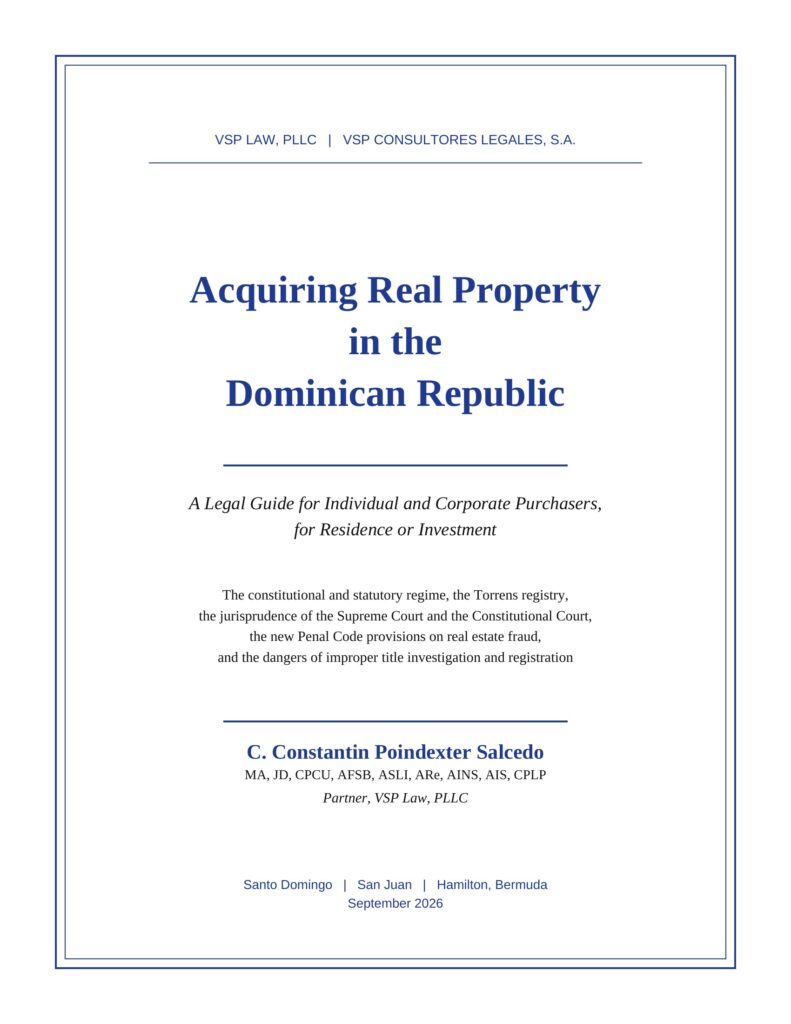
VSP Consultores Legales, S.A. announces the publication of Acquiring Real Property in the Dominican Republic: A Legal Guide for Individual and Corporate Purchasers, for Residence or Investment, a thirty-three-page treatment of the legal regime governing the purchase, holding and disposition of Dominican real estate. Authored by firm partner C. Constantin Poindexter Salcedo, the Dominican Republic property guide is written for the foreign and domestic purchaser, for family offices and corporate investors, and for foreign counsel who require a reliable working understanding of a system that rewards diligence and punishes informality with equal rigor.
The publication arrives at a moment of unusual activity in the Dominican market. Tourism development in the eastern and northern provinces, remittance-financed housing demand, and a steady inflow of retirees and second home purchasers from North America and Europe have produced two decades of nearly uninterrupted construction. That growth has been accompanied by a rise in title fraud, pre-construction losses and boundary litigation, much of it suffered by purchasers who did not understand that the Dominican registry protects only the person who investigates, contracts and registers correctly. The guide was written to close that gap.
What the Dominican Republic property guide covers
The work begins with the constitutional foundation of property rights under Article 51 of the Constitution and proceeds through the Torrens system as codified in Ley 108-05 de Registro Inmobiliario. It explains the principles of specialty, legality, publicity and authenticity on which the registry rests, the constitutive character of registration under Article 90, the imprescriptibility of registered rights, and the institutional structure of the Jurisdicción Inmobiliaria, including the land courts, the Dirección Nacional de Mensuras Catastrales and the Registro de Títulos. It devotes particular attention to the variants of title a purchaser will encounter in the market, distinguishing the individualized certificate of title from the constancia anotada and from the possessory rights that circulate over unregistered land, and it explains why each carries a different risk profile.
The guide then walks the reader through the acquisition itself: the engagement of independent counsel, the structure of the promise of sale, the documentary, registral, cadastral, physical and personal dimensions of a proper title investigation, the drafting of the definitive contract, payment through the regulated banking system under Ley 155-17, the computation and payment of transfer tax, and the filing that produces a new certificate of title in the purchaser’s name. A separate chapter addresses the vehicles available to purchasers, comparing personal ownership, the sociedad de responsabilidad limitada, the registration of foreign companies and the fideicomiso under Ley 189-11, and explaining how the choice of structure interacts with the property tax, forced heirship and the succession regime.
The new Penal Code and the jurisprudence of the high courts
Two features distinguish this Dominican Republic property guide from the summaries that circulate in the real estate trade. The first is its treatment of the criminal law. Ley 74-25, the new Código Penal, entered into force in August 2026 as amended by Ley 44-26, and it restructures the offense of fraud, creates an aggravated form for fraud whose object is real property with penalties of five to ten years, introduces criminal liability for legal persons, and modernizes the offenses of breach of trust, forgery of public documents and unlawful occupation. The guide explains what these provisions mean for developers, agents, attorneys in fact and the purchasers who deal with them.
The second is its engagement with case law. The publication traces the Constitutional Court’s development of the doctrine of the tercer adquiriente de buena fe y a título oneroso from TC/0093/15 through decisions of 2025 and 2026, identifies the four conditions a purchaser must satisfy to claim the registry’s protection, and explains, with reference to TC/1123/23 and TC/0614/19, why a recorded opposition or litigation notice defeats any later claim of good faith. It also reviews recent cassation decisions of the Tercera Sala of the Supreme Court and the one year revision period that follows an adjudication of unregistered land.
A catalogue of recurring losses
The most practical section of the Dominican Republic property guide is a catalogue of sixteen recurring mechanisms of loss drawn from the author’s practice: the photocopied title, the forged power of attorney, the impersonated owner, the double sale, the undisclosed mortgage, the constancia anotada, the purchase of possessory rights, the encroachment on the sixty-meter maritime zone, the developer without a trust, the undetermined heirs, the unconsenting spouse, the company without authority, the unpaid assessments, the under-declared price, the agent acting as escrow, and the squatter. Each entry identifies the mechanism, explains why the registry does not protect against it, and states the precaution that would have prevented it. A closing checklist consolidates the documents and confirmations counsel should have in hand before any funds are released.
The guide also addresses taxation of the acquisition, holding and sale of property at 2026 rates and thresholds, the incentives available under Ley 158-01 and Ley 171-07, anti-money laundering compliance, financing, the relationship between property ownership and residency, and dispute resolution before the land jurisdiction.
Availability
The Dominican Republic property guide is available for download without charge. VSP Law advises individual and corporate purchasers on the acquisition, structuring, financing and disposition of Dominican real property from offices in Santo Domingo and San Juan, Puerto Rico, and welcomes inquiries from prospective purchasers and from foreign counsel who require Dominican support on a transaction.
← Back to the blog